
On This Page
Horror movies of the 1970s reflect some of the grim social developments of the decade. After the optimism of the 1960s, with its sexual and cultural revolutions the Seventies represented something of a downturn. By 1970, the party was over; the Manson family killed the California hippie dream, the Beatles split, Janis and Jimi died, and it was downhill all the way from there: Nixon, Nam, oil strikes, skyrocketing divorce rates, and increasing dependence on “daytime sedatives” to cope with it all. The loneliness and selfishness of the ‘Me Decade’ begat the Age of Depression.
Fortunately, when society goes bad, horror films get good. In the 1970s horror makes its way back into the cultural spotlight. Horror movies dealing with contemporary social issues and addressing genuine psychological fears were big hits during the decade. Consequently, big name directors lined up to produce horror properties. This attracted big studio budgets that would have made Herschell Gordon Lewis’s head explode. The Exorcist (1973) was even nominated for ten Academy Awards, winning two.
Not In Front Of The Children
Fear of children is evident in many 1970s horror movies, especially the fear of the messy, painful and sometimes fatal process of pregnancy and childbirth. Perhaps this was a consequence of men writing and directing all the movies? David J Skal, in The Monster Show, identifies this fear as stemming from the introduction of the contraceptive pill, and from the birth defect horrors forced on the western world by thalidomide. Once sex and conception have been separated, and sexual activity becomes primarily a pleasure, the by-products (i.e. children) become monstrous aberrations.
The debate raging around abortion fueled the paranoia. The landmark 1973 Roe vs. Wade decision that made such terminations legally available in the United States loomed large in cultural consciousness. Along with widely prescribed oral contraceptives, this made family planning a practical reality for couples. Pregnancy was no longer a matter of luck or divine favor (or retribution). In theory, this meant no more unwanted children. However, bigger issues such as overpopulation and impending environmental disaster concerned parents-to-be. Even if they wanted a child, should they add to the burgeoning and destructive human species? Would their baby be mutated by environmental pollutants or medication side effects even before it was born?

Feminism in 1970s Horror
1970s horror movies also confront the issues surrounding women’s demands for gender equality. Building on the successes of the 1960s, a new generation of women fought for their rights to an equal education and opportunities in the workplace.
Second-wave feminism compounded the sensation of fracture within traditional family structures. Married women wanted to work too, rather than being stay-at-home helpmates for their husbands. It became a lot easier for a woman to get a divorce and strike out alone, with the law usually favoring the mother when it came to granting custody of the kids. Men, once they became aware of this trend, pushed back, beginning the modern phase of the men’s rights movement.
Family Values in 1970s Horror
The crumbling family unit generated much fear and mistrust, especially for men. Filmmakers – who in the 1970s were almost always men – used horror to reflect their personal fears about the way the world was going and their changing role in it.
Consequently, in many 1970s horror movies, the Other isn’t a shapeshifting alien crash landing from another planet. Instead, the Other lurks inside your own home: it’s your Mum (The Brood); Dad (The Shining); brother (Halloween); sister (Alice, Sweet Alice); husband (The Stepford Wives); newborn (It’s Alive); little boy (The Omen); pre-teen (The Exorcist); the people in your life you see so often you don’t really see them any more (Carrie).
1970s horror movies acknowledge that small, personal stories, of a marriage breakdown, or a troubled child, can be intense and terrifying – more so than abstract tales of the supernatural, because they are so real and so terrifying.
It’s Alive (1974)

Writer-director Larry Cohen began his career creating television shows before he moved into low-budget genre movies (horror and Blaxploitation, mainly). By 1974, he had cemented a reputation for campy humor, wry social commentaries, and well-rounded characters facing dilemmas audiences actually cared about. It’s Alive certainly helped define the ‘Keep It In The Family’ vibe of horror movies in the mid-1970s. This ‘monster baby’ movie landed in cinemas just a year after the Roe vs. Wade decision legalizing abortion in the United States. Whether intentionally or not, it plays into the ongoing furor about women’s reproductive rights, along with ongoing concerns about Big Pharma – the thalidomide scandal was very recent and very real.
Read More about IT’S ALIVE >>>>>>>>
The Stepford Wives (1975)

The first movie adaptation of Ira Levin’s 1972 novel (he also penned Rosemary’s Baby) is a chilling affair. Best described as a satirical horror thriller, it channels both pro- and anti-feminist sensibilities of the time, as well as tapping into the humans-as-robots sci-fi trope explored by Westworld. “Stepford Wife” has entered our language as a term to describe any woman who is spookily submissive, and “Stepford” is a derisory term for any suburb that is stultifyingly bland.
Read More about THE STEPFORD WIVES >>>>>>>>
The Brood (1979)

Shivers (1976) and Rabid (1977) established Canadian director David Cronenberg at the forefront of psychosexual body horror and The Brood (1979) caps off his 1970s work with a flourish. Within Cronenberg’s unique vision, human flesh is itself monstrous, capable of mutating, detaching, slithering, and destroying its progenitor. His movies of this decade burrow deep inside the human reproductive system and the urges that drive it, emerging drenched in blood and quite, quite demented. They refract male envy of pregnancy and childbirth by presenting alternative, non-sexual methods of reproduction. His narratives straddle the border between science fiction and horror, often including a cool, dispassionate doctor who, when consulted, regards the abominations of nature on display with only mild curiosity, as if they are the predictable consequences of human evolution: This is who we really are, this is what has always bubbled beneath our skin. Step across the threshold and embrace it.
Read More about THE BROOD >>>>>>>>
Religious Horror in the 1970s

By the 1970s, the Production Code’s “Do’s, Don’ts, and Be Carefuls” regarding religion had disappeared. Of course, religious leaders could still organize opposition (usually in the form of boycotts) to any individual movies they considered blasphemous or offensive – a great way of drumming up outraged newspaper headlines and earning free publicity for the offenders. “Banned” is always a badge of honor for a B-movie poster.

In horror movies of the 1970s, the Devil seemed eager to prove to the world that he did, indeed, exist. Filmmakers relished the opportunity to work previously forbidden imagery of witches, demons, and naked, moonlit rituals into their screen stories. These ideas meshed well with the new mood of sexual permissiveness and a growing interest in stories about outsiders and antiheroes. Some individuals, raised by harsh, even abusive nuns and priests, relished the opportunity to rewrite Catholic teachings about demons. It was an opportunity to get back at their childhood persecutors. It can be liberating to stomp all over a once-sacred symbol.
Tropes such as devil worshippers, white-clad virgins, possessed children, sex-starved covens, and the invocation of forgotten rites proved popular with audiences in the 1960s and early 1970s. Titles consisting of various combinations of the words “devil”, blood”, “Satan”, “witch”, “demon”, “orgy”, “mark”, “cult” and “secret” made fun Saturday night double and triple bills at rep theatres and drive-ins. ‘Nunsploitation’ was a thing.

Religious horror attracted serious filmmakers too, eager to emulate the mainstream success of Rosemary’s Baby in 1968, and to participate in the cultural discourse surrounding the much-ballyhooed demise of organized religion. In 1966, Time magazine asked Is God Dead?, putting crisis of faith on the cultural agenda. It’s no surprise that so many novels and movies of the era involve direct confrontations with the devil himself.
The Exorcist (1973)

I tried to make a film with no sense of style, with no sense of doing something that would ever remotely be classified as a horror film or a work of fantasy. I attempted to make it as realistic as possible. At the very most, I think it could be called a work of the inexplicable. By now I accept that The Exorcist does belong in the horror genre. At the time I didn’t.”
William Friedkin’s acceptance speech for The Exorcist at The Academy of Science Fiction, Fantasy and Horror Awards Ceremony at the University of Southern California, June 11, 1981
The Exorcist was based on one such novel, William Peter Blatty’s 1971 bestseller. William Friedkin’s masterpiece frequently tops ‘scariest movie of all time’ lists. It managed to entertain non-believers, freak out fundamentalists, and scare former Christians back into the arms of their church. The special effects (created mechanically, on set, rather than added in post-production) dazzle even by today’s standards.
The Wicker Man (1973)

The Wicker Man is another 1973 release that has only grown in reputation over the years. It’s rooted in a much older religion than Catholicism. It channels the British paganism made popular in the early 20th century by Margaret Murray (known as the Grandmother of Wicca) and Sir James George Frazer (author of The Golden Bough).
Based on David Pinner’s 1967 novel, Ritual, Robin Hardy’s film was very misunderstood – most notably by its distributor – when it was made. This resulted in a bastardized version being released as the supporting feature to Don’t Look Now. The original version might have been lost forever, but thankfully an intact print was sent to Roger Corman for review, and he saved it for posterity. The Wicker Man was hailed as “the Citizen Kane of horror” by Cinefantastique in 1977, and is now seen as the grandaddy of the current wave of folk horror – Sightseers (2012) and Midsommar (2019) would not exist without it.
Alice, Sweet Alice (1976) (aka Communion, Holy Terror)
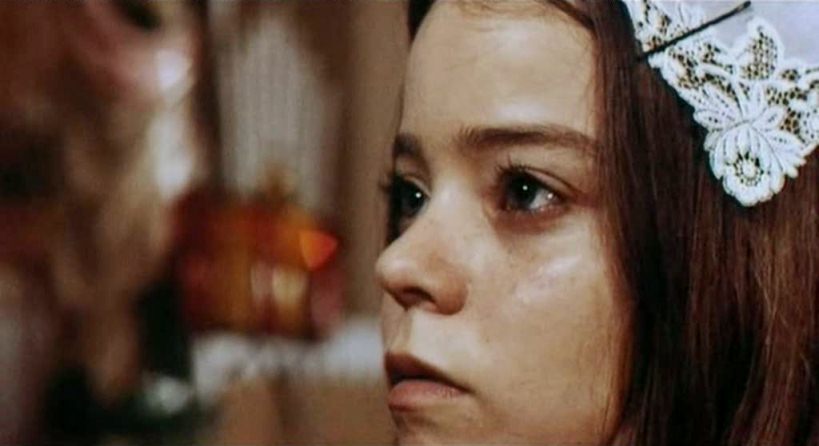
—Dr. Whitman (Louisa Horton)
Alice, Sweet Alice begins with a vicious case of sibling rivalry and explodes into a critique of all levels of family ties. It’s drenched in Roman Catholic ideology, iconography and guilt. Director, Alfred Sole (making his first non-pornographic feature) indulges a tendency towards quite brutal onscreen violence. While it’s often overlooked in lists of the best 1970s horror movies, Alice, Sweet Alice rewards deeper examination. The production design captures the intimate, often shabby details of New Jersey Catholicism. Rosemary Ritvo’s screenplay embraces the sheer ugliness of dealing with a death within the family that isn’t really equalled until 2018’s Hereditary.
Read More About ALICE, SWEET ALICE>>>>>>>
Carrie (1976)

Based on another bestselling novel (Stephen King’s 1974 debut), Brian de Palma’s take on Carrie (1976) is quintessentially 1970s, shot using vivid hues, split screen and soft focus stylized effects, and culminating in a gore-drenched finale. It’s anchored by a spectacular performance from Sissy Spacek. She depicts Carrie as the classroom reject the other kids beat up on without really knowing why.
The Omen (1976)

Other filmmakers looked at the success of The Exorcist and began scrambling to make their own glossy Catholic-tinted horror blockbuster. Most notable among the pack of post-Exorcist copycats is The Omen (1976). It tells of the coming of the antichrist, in the form of a spoiled, angry boy child. The Omen had everything 20th Century Fox’s money could buy: elite international locations; an A-list cast (including Gregory Peck and Lee Remick); an Oscar-winning score from Jerry Goldsmith; spectacular stunts and special effects sequences; and a no-holds barred publicity campaign that co-opted Biblical predictions about the end of the world. It grossed more than $60M in box office.
The New Wave
Not all 1970s horror movies are about children or religion. The 1970s is also the decade when the first so-called movie brats (the first generation to grow up with television and the level of visual literacy that brings) leave film school and let loose on their own movies (Spielberg, Scorsese, Lucas, de Palma et al). Also, writer Stephen King hits the bestseller lists with his 1974 debut, Carrie. These are people who grew up watching the Universal horror classics and The Addams Family on TV and playing with their Aurora Monster kits. This new breed of creatives were well versed in the genre paradigms and steeped in genre history. They knew intimately how a horror film should look and how a monster should behave – and how a skilled director might start playing variations on the well-worn themes.
Jaws (1975)

With Jaws, Spielberg took what could have been turgid B-movie fare and turned out a masterclass in suspense. It was a massive success – from a budget of $12M US its total gross was well over $400M – and began the era of the modern Hollywood blockbuster. It was the first film to exceed $100M in box office receipts. Jaws built on the mainstream appetite for horror created by films such as The Exorcist, but gave us a monster that was, uniquely, neither human nor supernatural nor the result of mutation. Sharks are real. They’re out there, swimming around, snacking on swimmers, right now. The movie’s success is rooted in this terrifying premise, as well as in the inspiration taken, in terms of marketing and distribution as well as content, from the big monster movies of the 1950s.
The Rise of the Slasher Subgenre
Although Psycho and Peeping Tom (both 1960) are generally agreed to be the first slasher movies, it takes more than a couple of creepy killers, with sharp weapons, in disguise, to define a subgenre. While American horror filmmakers turned to the technicolor demonology of the 1960s, the Italians jumped on the conveniently low budget concept of a masked, gloved predator, which fitted neatly into the burgeoning ranks of giallo – movie adaptations of the cheap yellow-jacketed pulp murder mysteries popular in Italy in the mid-20th century. Among others, Mario Bava refined Hitchcock’s basic recipe with his black and white thriller The Girl Who Knew Too Much (1964) and the lurid color of Blood and Black Lace (1964).
Over the next decade or so, giallo movies established the tropes of the mysterious and largely motiveless murderer who invades the homes of the young, beautiful, and terrified, before slaughtering them, one by one, with whatever domestic objects come to hand, such as kitchen knives, decorative hooks, garden tools, curtain cords, etc. Giallo killers prefer to conceal their faces (and identities) for as much of the movie as possible. The audience only ever glimpses fragments – shoulders, hands, feet. Any sense of who this character might be comes from hints about his or her backstory, and lecherous POV shots accompanied by heavy breathing and guttural moans. These plot essentials – often enlivened by psychosexual nightmare sequences reminiscent of silent horror – were easily replicated and seemed to be endlessly appealing to audiences. A paradigm was born.
After the Manson family rewrote the giallo template into a frenzy of news headlines in August 1969, it was inevitable that North Americans would become fascinated by stories about senseless home invasion killings – once the Family were safely behind bars. The bleakness of giallo tropes – you’re not safe, even in your own home, and if you call the cops they’ll think you’re crazy –fitted neatly with the mood of the times. So too, did the misogyny inherent in the nascent subgenre. Giallo, and later slasher movies revolved around the persecution, torture and murder of young women, often framed as free-spirited, anti-authority, braless individuals who somehow deserved bloody punishment for their growing resistance to patriarchal norms. It’s hardly surprising that the slasher became a key figure in 1970s horror movies.
Black Christmas (1974) aka Silent Night, Evil Night

Black Christmas wasn’t the first 1970s horror movie to center on a Christmastime spree killer. That territory was mapped out, somewhat crudely, in 1972 by Silent Night, Bloody Night (directed by Theodore Gershuny and co-produced by Lloyd Kaufman). However, the sorority house setting, sharp script (by Ray Moore), stellar cast (Keir Gallea, Olivia Hussey, Margot Kidder) and nuanced direction of the Canadian film mean it’s often referenced as a definitive slasher. It was a hit upon first release in Canada, but stumbled in the USA – possibly because of a clumsy title change. US distributors didn’t want audiences to think it was a blaxploitation film so they renamed it Silent Night, Evil Night – clunky, and too similar to the unappealing Gershuny film. Over the years, it’s gained status as a cult classic and has been remade twice (in 2006 and 2019).
The Texas Chain Saw Massacre (1974)

Future Master of Horror (who would work on many projects with Steven Spielberg in the 1980s and 1990s) Tobe Hooper made his dramatic debut in 1974. From the very first seconds of The Texas Chain Saw Massacre, the flashed images of decomposing flesh, to the subsequent news report detailing grave-robbing in rural Texas, followed by the oozing red sunspots of the title sequence, and the opening narrative shot of armadillo roadkill, the viewer is transported to a nightmare zone where usual moral parameters are null and void. That’s just the first five minutes. The rest of the movie involves a slow, measured descent into the madness of the Sawyer family, and culminates in a final ten minutes of torture and terror that begins around their dinner table. Domestic violence gets extreme.
Read more about THE TEXAS CHAIN SAW MASSACRE>>>>>>>
Halloween (1978)

Another future Master of Horror, John Carpenter cemented his reputation with Halloween (1978). Often imitated, never equalled, this low budget ($325,000) masterpiece took all the suspense of Psycho and repackaged it in color with teenage protagonists – a knowing nod to the market. Although credited with spawning subsequent slash and gore pics of the 1980s, it contains relatively little blood, instead relying on shock and the unrelenting build-up of tension. Once again, the premise is simple – teenage babysitter tries to escape the attention of a rampaging serial killer – but Carpenter’s deft use of shadows and score (he composed it himself) made it horrifying and fresh, although subsequent over-use of its elements have turned them into clichés.
Read More About HALLOWEEN>>>>>>>
Further Reading
- Stained Lens: Style as Cultural Signifier in Seventies Horror Films – lengthy, well-written essay on Last House on the Left, Texas Chainsaw Massacre and Hallowe’en
- Men, Women and Chainsaws – Carol J. Clover (Princeton University Press, 1993)
- Critique of the above– Branislav L. Slantchev
- Women and Horror Movies – Donato Torato
- The Baying of Pigs: Reflections on the New American Horror Movie – Jack Sargeant in Senses of Cinema